Diagnostics and troubleshooting
First checks
uv run nativehtmlkit-python version      # SDK, protocol and host provenance (exit 1 if the host is missing/mismatched)
uv run nativehtmlkit-python doctor       # the host's own environment report
Turn on tracing
NATIVEHTMLKIT_DIAGNOSTICS=trace uv run app.py
# or: uv run nativehtmlkit-python --diagnostics trace run app:setup
Records go to ~/.local/state/nativehtmlkit/diagnostics/ (Linux) or
%LOCALAPPDATA%\NativeHTMLKit\diagnostics\ (Windows), or NATIVEHTMLKIT_DIAGNOSTICS_DIR. They
contain names, ids, counts and timings, never your data. Export one session as a ZIP for a bug
report with uv run nativehtmlkit-python support bundle.zip. Details: diagnostics reference.
Symptoms
"My handler never runs."
Look for document.dispatch records with your event_type: matched: 0 means the event arrived
but no subscription matched. Usual causes:
- element= names an element that is not the target or an identified ancestor of it. Print
event["element"] and event["path"] from a document-wide handler.
- The event does not bubble (invalid, focus, blur, toggle, close, mouseenter):
subscribe on the target or without element.
- You subscribed on an old document. load_html/load_file create a new window.document.
- You expected an event from a programmatic change: set_value and friends fire no events.
StaleDocumentError.
The window closed or the document was replaced. Use window.document (not a saved reference),
check window.closed, and catch NativeHTMLKitError in background threads.
RpcError -32602 "Unknown element ID".
The id is not in the current document (typo, element removed by a re-render, or the action runs
against the wrong window).
RpcError -32001.
Not available in this session: headless mode (NATIVEHTMLKIT_TEST_MODE=1), no desktop service
(e.g. no file-dialog portal), or platform policy (Wayland placement/focus). See
app.capabilities()["features"].
RpcError -32005.
A limit: window count, 1 MiB inline HTML, bitmap budget, one native dialog per window, too many
pending requests.
The window freezes / events arrive late.
A callback is busy (slow work, wait=True dialog). Look at callback.completed duration_ms in a
trace. Move work to a thread or use wait=False. Dropped events show up
as rpc.notification_dropped and in app.rpc.dropped_notifications.
My print() output is missing.
Backend output is relayed by the launcher on every diagnostics level. When you started the host
yourself (nativehtmlkit-python-host run --app), look at the host's standard error.
The application exits with status 1 right after start.
Read the relayed traceback. Typical: an exception in main()/setup(), a window closed before
app.ready, start-up took longer than startup_timeout_ms, or app.close() was called.
StartupError / HostVerificationError.
No usable host: use a platform wheel (Linux x64 glibc 2.39+, Windows x64), not the source
distribution; reinstall if the bundled host fails its SHA-256 check. NATIVEHTMLKIT_HOST_BINARY
overrides the host for development.
CSS does not apply.
document.diagnostics() lists unsupported CSS and pending resources;
document.computed_style([...], "id") shows the effective values and
document.command("explain", element="id", property="color") explains one.
An About / Support window
diagnostics.py puts the useful facts in one window: platform,
renderer and headless state from app.capabilities(), which native services the host offers and
whether it has observed them (see below), the desktop preferences, loss counters from
app.host_diagnostics() and the SDK recorder, and a Save support bundle button:
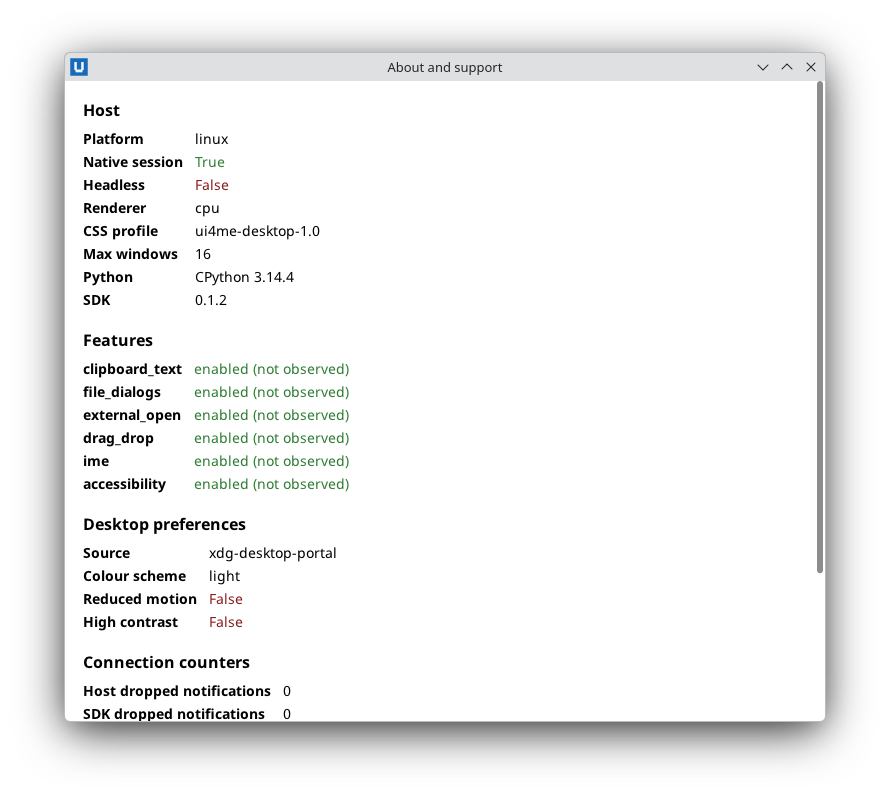
Real capture on KDE Plasma 6.6 Wayland with the released packages.
from nativehtmlkit import diagnostics, export_support_bundle

caps = app.capabilities()
offered = caps["file_dialogs"]                     # top-level flag: the API is enabled in this session
observed = caps["features"]["file_dialogs"]["available"]   # True/False once observed, None before
host = app.host_diagnostics()                      # dropped_notifications, pending_jobs, ...
failures = sum(r["event"] == "callback.failed" for r in diagnostics.recorder().history())
path = export_support_bundle(folder / "support.zip", overwrite=True)   # manifest.json + timeline.jsonl
Treat None as "not observed", never as "unavailable": on a native desktop, Core 1.0.3 reports
available: None for these services (availability is established by the native request itself)
while the top-level flag is True; headless it reports False for both. The example's
feature_state() turns the pair into one of "available", "enabled (not observed)",
"unavailable" or "not available". The top-level flags are clipboard_text, file_dialogs,
external_open, drag_drop, ime and accessibility; the matching feature entries have the same
names except drag_drop, which is incoming_drop.
The bundle is written locally and contains no document text, form values or paths.
Testing without a desktop
NATIVEHTMLKIT_TEST_MODE=1 runs the real host headless. Everything except native services works,
and you can drive forms with request_submit and read state back with get_text, query_nodes,
computed_style, validity and so on. This repository's tests/integration/example_checks.py
tests every example that way.
Source: nativehtmlkit-python/docs/guides/diagnostics-and-troubleshooting.md · edit the page there.